Labor minister visits UNESCO-listed qanat in northeast Iran
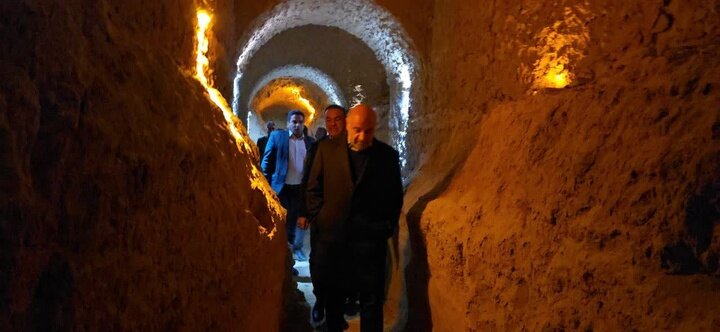
TEHRAN – Minister of Cooperatives, Labor and Social Welfare Ahmad Meydari visited the UNESCO-listed Qasabeh qanat in Gonabad, northeast Iran, on Friday. The ancient aqueduct is widely considered as the deepest known qanat in the world.
Meydari was accompanied by Mohammad Ali Nabipour, deputy governor-general of Khorasan Razavi province, Gonabad governor Mohammad Zarei, provincial labor officials and lawmaker Hadi Mohammadpour, who represents Gonabad and Bajestan in parliament, according to the cultural heritage news agency Miras Aria.
Situated in Gonabad, about 285 km south of Mashhad, it dates back more than 2,000 years and remains a key source of water for the region.
Stretching about 33 km, the qanat consists of three main branches – Qasabeh, Doulab-e Nou and Doulab-e Kohneh – and includes 472 wells, with a maximum depth of more than 320 meters, cultural heritage officials say.
The site, altogether with several other Iranian qanats, was inscribed on UNESCO’s World Heritage List in 2016 as part of the “Persian Qanat” serial nomination, during the 40th session of the World Heritage Committee in Istanbul.
Hamidreza Mahmoudi, director of the Qasabeh Qanat World Heritage site, said the qanat has been less affected by drought due to its access to deep underground water sources.
Recent dredging has increased water flow from about 130 liters per second to 151 liters per second, he said, adding that the qanat continues to supply water for urban and rural use in the area.
Mahmoudi said conservation and infrastructure work at the site has included reinforcement of underground access routes, installation of signage, basic visitor facilities and the development of a designated tourism zone covering about 200 hectares.
He added that a 2.7-km tourist route linking key historical and religious sites related to the qanat is under development, alongside a comprehensive management and tourism plan being prepared in cooperation with the University of Tehran.
Digging new wells within the Qasabeh qanat’s protected zone has been banned since the 1960s, a measure officials say has helped preserve the ancient water system despite widespread depletion of other qanats in the region.
KD
Leave a Comment